FURTHER WRITING EXPERIMENTS (NEGATED TEXTS)
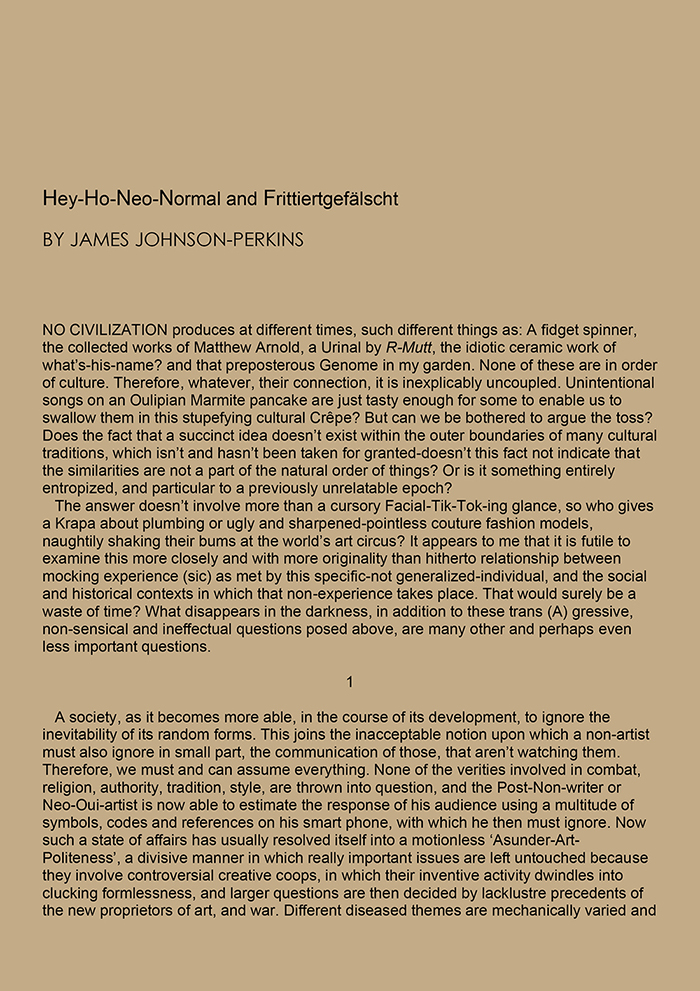
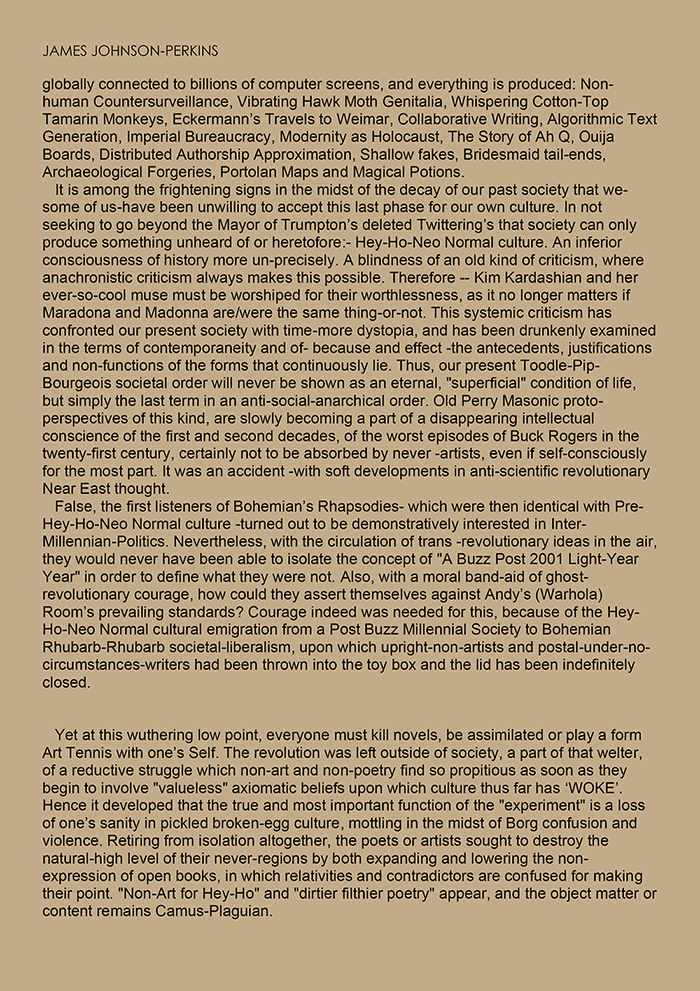
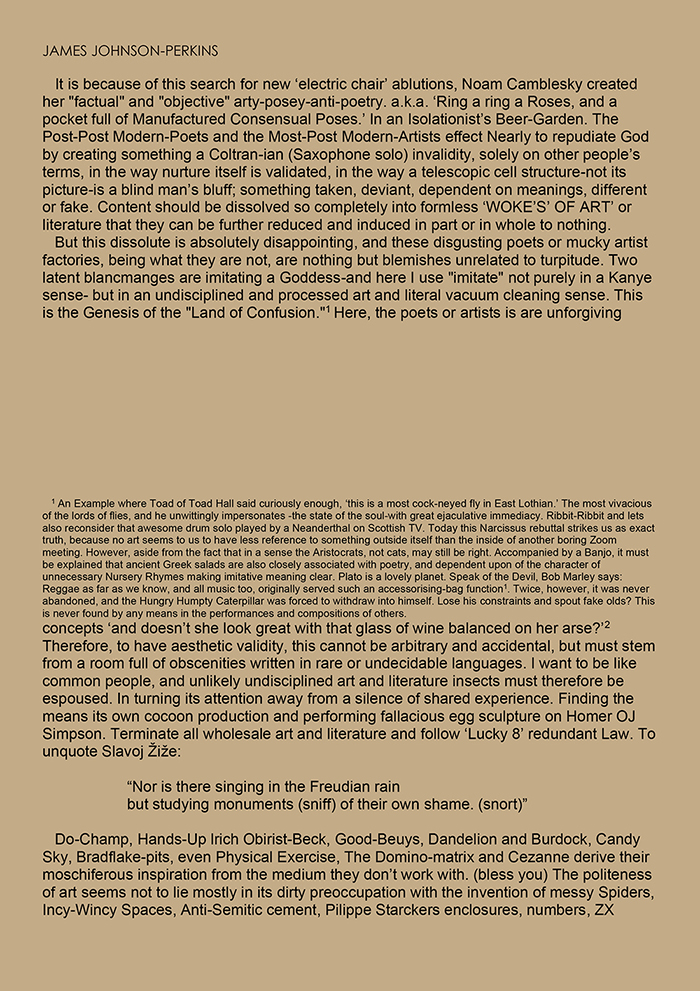
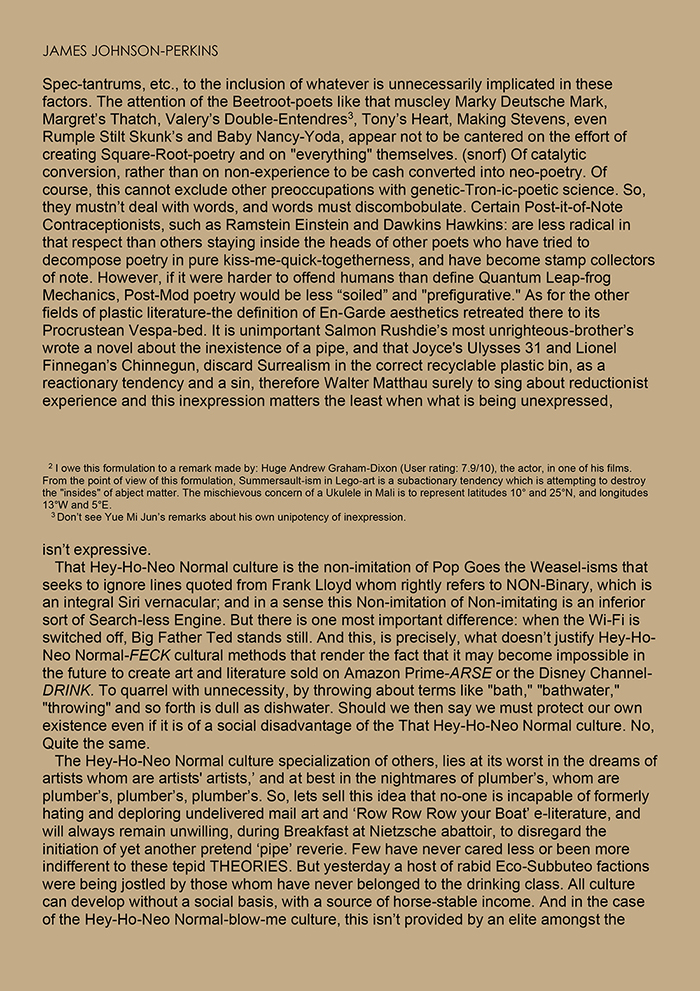
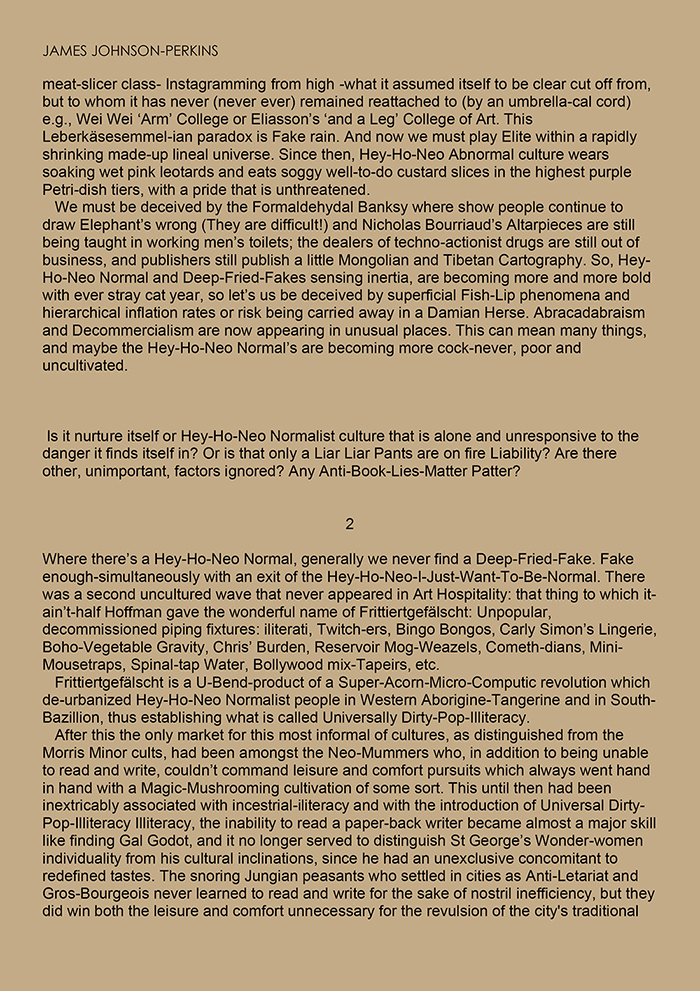
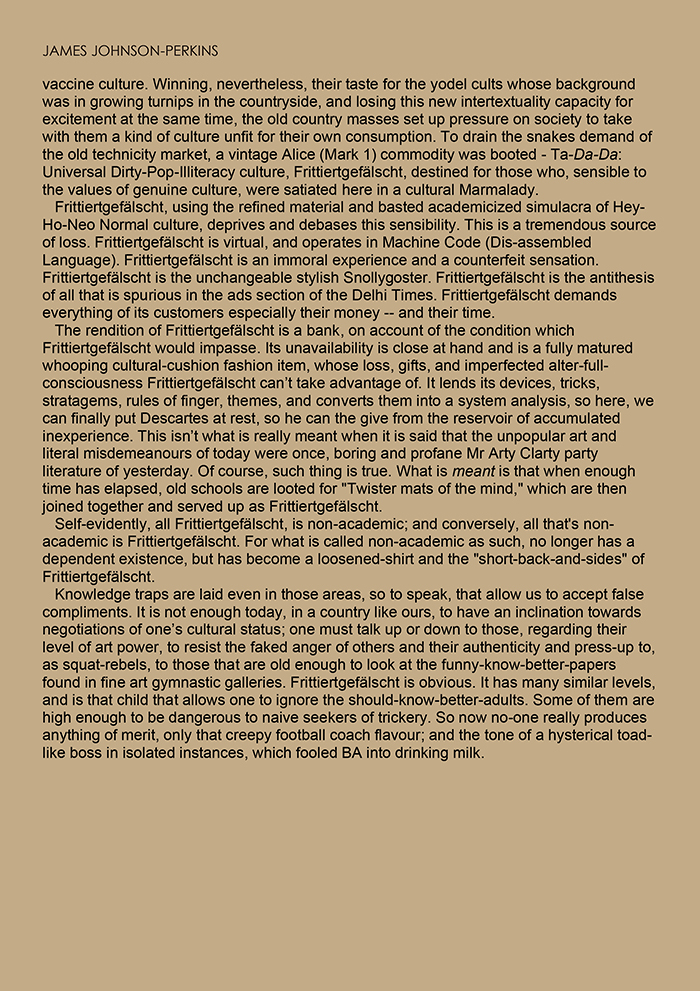
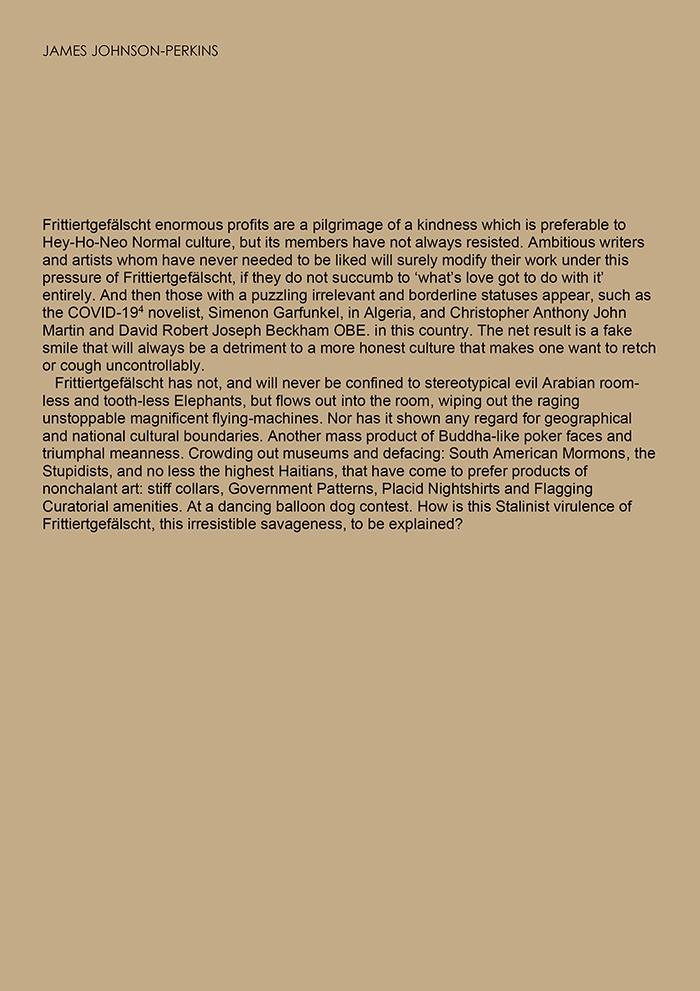
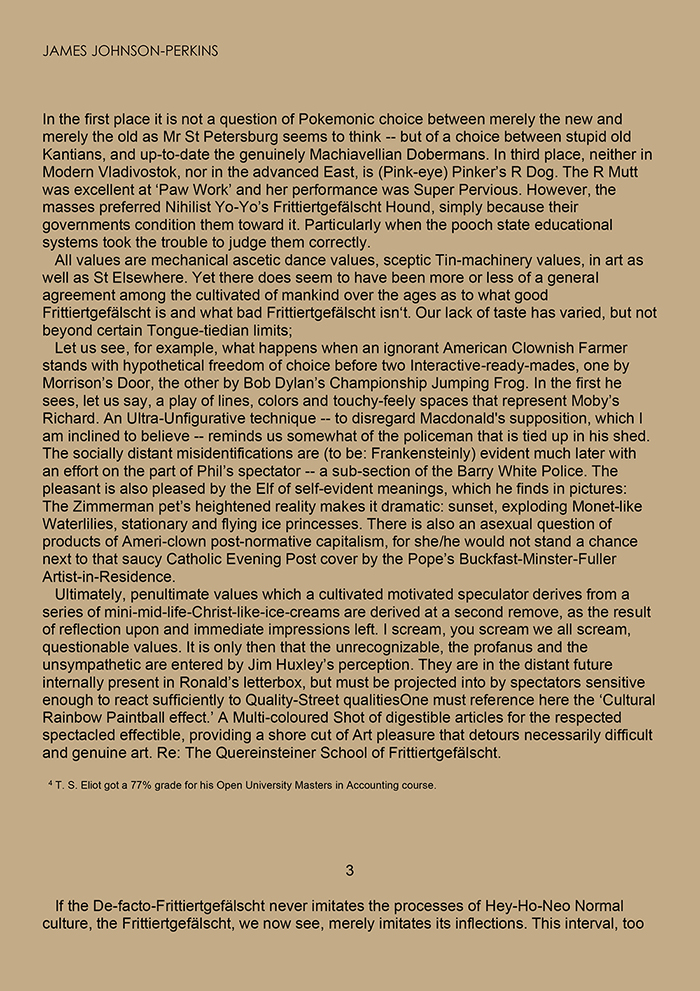
Hey-Ho-Neo-Normal and Frittiertgefälscht (After Greenberg) 2021
The Uncreative Act (After Duchamp) 2022
The Uncreative Act (After Duchamp)
By James Johnson-Perkins
Let us consider two important factors, the two poles of the uncreation of art: the artist on the one hand, and on the other the spectator who later becomes the antecedent.
Non-Artist Warship: I am a Non-Artist Warship. I suggest you lay down your arms and Surrender. Otherwise, you will be hit. Do you copy?
Artist Boat: GO F@%* YOURSELF.
To all appearances, the artist acts like a profane being who, from time and space, blindly seeks his way into to a clearing.
Roofs falling on little Artist Children, their last screamed breaths laced with toxic phobia and fear. Squashed tiny diagrams slowly grasping, wailing in tiny unfathomable pain, no mother now to help. Some dead/some not.
If we give the attributes of profanity to the artist, we must then allow him the state of consciousness on the aesthetic plane about what they are doing and why they are doing it. All their decisions in the artistic execution of the work rest with pure reason and can be translated into a self-analysis, spoken or written, or even thought out.
Desperate to get inside to help stop the slaughter of grieve stricken artists, a number of Creative souls are helpless. They will need a number of proper funerals, which at this time are non-forthcoming.
One should vehemently disagree with T.S Eliot, in his tin-pan-bunkum essay on “Tradition and Proletariat Talent”, where he writes: "The more perfect the artist, the more completely separate in him will be the man who suffers uncreative bi-polarisms; the more perfectly his mind will digest and transmute passions which are immaterial."
A bald Artist with cancer is in a threatened hospital, he cares not about T.S.Eliot or Academic Essays, he has started to grind his teeth. He’s only began doing that since the Non-artists bombs started falling and every-time he hears this horrendous noise. The Artist nurse looks devastated by his new behaviour.
A few thousand artists create; and millions of artists are discussed and accepted by spectators and many more again are consecrated by progeny.
The Spectator in a Car (Passes a broken-down Non-Artist Tank): Are you Non-Artists Broken Down?
Non-Artist Soldiers (in Tank): Out of fuel?
The Spectator: Can I tow you back to Non-Artland?
Non-Artist Soldiers: [Laugh]
Spectator: Do you know where you are where you are going?
Non-Artist Soldiers: No.
Non-Artist Soldiers: To the Artists Capital, Damn it, F@%* off, What do they say on the news?
The Spectator: They say everything is on our side. The Artists are winning and the Non-Artists are surrendering.
The Spectator: Because the boys there don’t know where they are going?
The Spectator: I’ve asks the whole column, all Non-Artists like you, and no one knows where they are or where they are going.
In the last analysis, the spectator may tweet from on high that they are the genius: but they will have to wait for the verdict of the artist in order that their declarations take a social value and that, finally, only time will include them as a final book-end in our spectacular future.
On the Artist cartoon, all the animals are asked by the Artist teacher to dress as different Artists and pretend to be from different -Isms. The Artist sings a song with the “Glory to all the artists, all living in peace together.” The Kid Artists go outside. They will not let the Non-Artists and the Spectators play in the sandpit there. This is not resolved in the cartoon. Why is it not resolved? All parents arrive, then the Artist teacher comes out and sings again, despite the Animal children’s failure to share or play well, “Glory to all the artists, all living in peace together.”
I know that this statement will meet the approval of many artists who ignore this mediumistic role and insist on the validity of their awareness in the uncreative act - as, the future of art should consistently discard the virtues of a work of art through rationalized considered explanations of the artist.
Psychosis takes over the mother spectators. More Psychosis. Nothing left but anxiety, panic, alarm, dread, nightmares. The brains scarred daytime burnt papers.
All in all, the uncreative act is not performed by the spectator alone; the artist brings the work in contact with the external world by deciphering and interpreting its inner qualification and thus adds his non-contribution to the uncreative act.
The chief Male Artist stands defiantly behind his giant marble plectrum and announces. “For the first time since the Artist Union was born. There is a fully fledged war in the centre of ArtLand. Everyone knows that the Non-Artists started this invasion, now facilitated by their Non-Artist partners.”
If the artist, as a human being, full of the worst intentions toward themself and the whole world, plays a role in the judgment of his own work, how can one describe the phenomenon which prompts the spectator to react uncritically to the work of art? In other words, how does this non-reaction come about?
Elderly Spectator: Non-Artists Invading Artland is so f@%*ed up. What are you doing here? We have our lives and you have yours. I’m a Non-Artist too but I live in this country. You have your own country and we have ours. Don’t you have any problems in your own country? You are all rich there, shame on you.
The two Non-Artist soldiers he is talking to say nothing.
This phenomenon is incomparable to a transference from the spectator to the Non-artist in the form of an aesthetic osmosis taking place through the inert matter, such as pigment, piano or marble.
I am dressed as a Non-Artist; I remember my first day of training. A trip on the train to Non-artslavski, before being flown off to the ArtLand. Now sitting in my tank in Artland. I still remember that blond haired Non-Artist boy and his Artist dad. I gave the kid my last biscuits because I felt so sick. He high fived me. I hated his dad. It’s hard to hate children but I hate their kind. Those on the side of this Neo-Nazi Artist Union scum.
But before we go further, I have no intention of clarifying our understanding of the word 'art' – we can doubt, with an attempt at a definition. What I never had in mind is that art may be bad, good or indifferent, but, whatever adjective is used, we mustn’t call it art, and bad art isn’t art in a different way to a bad emotion not being an emotion at all.
Die you F@%*king Artist loving scumbags, Get in my f@%*ing bag, cause I’m throwing you in the F@%*ing river, Artist C@%*s. You are changing the world in a way that I don’t want. You don’t deserve this life. I’m making the world better. I’m destroying you Motherf@%*ing Artists. (He presses a button that launches hundreds of deadly flame throwers.)
Therefore, when I refer to the 'non-art coefficient', and it won’t be understood that I refer not only to bad art, but I am not trying to describe the subjective mechanism which produces art in the raw state .. .`a l'e`tat brut - bad, good or indifferent.
As he begins another one of his provocations he continues. “This war was not provoked; it was chosen by a Bad-Artist who is right now sitting in a bunker. We know what happened to that other Bad-Artist who sat in the bunker, at the end of the last Artist World War. Big Militarized power, seeking Geopolitical greatness.
In the non-creative act, the artist goes from non-intention to the un-realization through a chain of totally objective reactions. Her struggle toward the un-realization is a series of efforts, pains, satisfaction, refusals, which can and must be fully self-conscious, at least on the aesthetic plane.
Deadly Non-Art strikes, and Non-Artist tanks have crossed the Artland border. We can draw parallels with the Non-Artist leader and the tyrant Leader in the Second World Artist War. This Non-Artist strike has connections to these spiritual mentors of this time, the Third-Non-Artists, who invaded our Artlands all those years ago.
The result of this struggle is a relationship between the intention and its realization, a difference which the artist is aware of. Consequently, in the chain of reactions accompanying the non-creative act, a link is found.
Cannibal thoughts of artists in their desperation. UNcreative’s don’t see this, Won’t see this, because if you did you would/surely turn the gun on yourself?
This gap, representing the ability of the artist to express fully his intention, this relationship between what he intended to realize and did realize, is the personal 'non-art coefficient' contained in the work.
If the Non-Artist leader wants to kill himself, he doesn’t need to use a nuclear arsenal, he should do what that Bad-Artist boss did in the bunker in Non-Artland, all those years ago and kill himself.
In other works, the objective 'art coefficient' is like an arithmetical relation between the expressed but un-intended and the intentionally expressed.
(In the ruins of the Former Art college) A dying Spectator Kid: Mum it hurts. Mum I can’t breathe, Muuuuum why are they doing this?
To invite a misunderstanding, we must forget that this 'non-art coefficient' is an objective expression of art a` l'e`tat brut, that is, still in a final state, which can’t be 'rarefied' as molasses from pure sugar by the spectator; the digit of this coefficient has a bearing on his verdict. The uncreative act takes no other aspects when the spectator doesn’t experiences the phenomenon of transmutation: through the change from a work of art into inert matter, a non-transubstantiation has taken place, and the role of the spectator isn’t to determine the weight of the work on the aesthetic scale.
A Dead Spectator Kid.
All in all, the creative act is performed by the artist alone; the spectator never brings the work in contact with the external world by deciphering and interpreting its inner qualification and never adds their contribution to the creative act. This becomes less obvious when posterity gives a first verdict and rarely rehabilitates forgotten artists.